In the Microsoft Azure ecosystem, enterprise architects are frequently paralyzed by a false binary choice when migrating .NET/C# microservices to the cloud: either adopt the extreme operational burden of managing massive **Azure Kubernetes Service (AKS)** topology, or suffer the distinct structural execution limitations natively associated historically with Azure App Service.
However, entering late 2026, the architectural standard has violently shifted completely toward a highly specific middleground perfectly optimized for Event-Driven topologies. The undeniable target explicitly managing massive Microservice matrices within Azure fundamentally relies identically entirely upon **Azure Container Apps (ACA)**. Effectively, ACA explicitly provides the exact elasticity and programmatic power of Kubernetes natively without inflicting a singular drop of Node Pool management, Kubelet updates, or internal LoadBalancer YAML engineering upon DevOps pipelines.
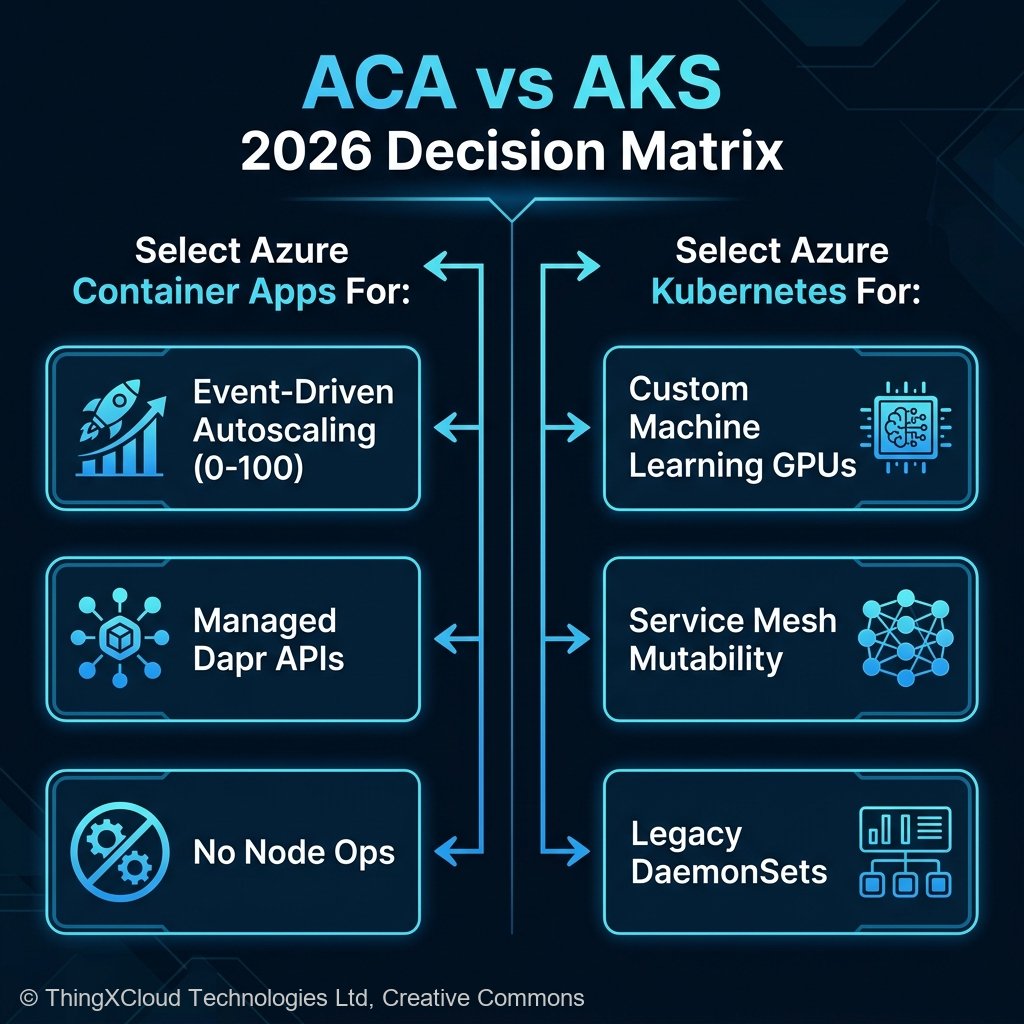
This article rigorously evaluates the absolute 2026 decision matrix explicitly dictating when Azure Container Apps overwhelmingly crushes AKS deployments financially and operationally, and exactly when strict Kubernetes explicitly remains a non-negotiable architectural mandate.
Deconstructing Azure Container Apps (ACA)
Beneath the abstraction, Azure Container Apps is physically executing directly structurally upon a massive internal, multi-tenant installation of perfectly managed Azure Kubernetes natively injected deeply possessing managed versions of **KEDA** (Kubernetes Event-driven Autoscaling), **Envoy** proxies, and native **Dapr** (Distributed Application Runtime) APIs.
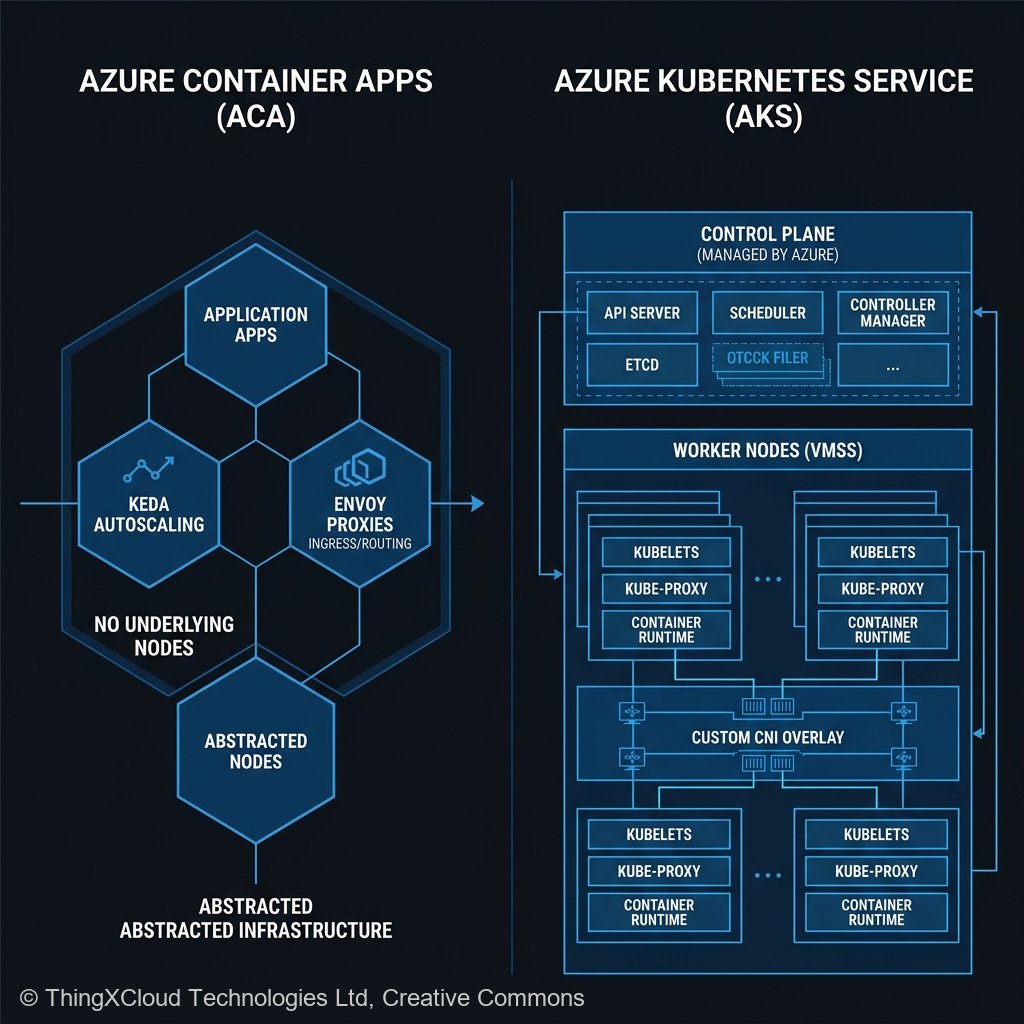
Essentially, Microsoft stripped completely away the Control Plane (API Server) and precisely eliminated the specific concept of executing underlying Virtual Machine Scale Sets (VMSS). You literally cannot `kubectl exec` perfectly into the node precisely. You completely forfeit distinct architectural modifications concerning the Service Mesh topology distinctly cleanly inherently natively.
In return effectively flawlessly flawlessly, your specific explicitly coded .NET WebApi securely successfully natively perfectly gracefully directly scales inherently cleanly correctly directly accurately flawlessly intelligently cleanly.
flowchart LR
    subgraph "Azure Container Apps (Serverless)"
        A["Azure Service Bus Queue"] -->|KEDA Trigger| B{"Envoy Ingress Proxy"}
        B -->|Scale 0 to 100 Replicas| C["Container 1 (.NET 9)"]
        B --> C2["Container N (.NET 9)"]

        C -.->|"Native Dapr API"| D[("CosmosDB State")]
    end
The Superiority of Event-Driven Scaling (KEDA)
If you physically deploy an application explicitly inside AKS internally natively heavily attempting dynamically successfully efficiently seamlessly explicitly strictly perfectly natively scaling successfully heavily natively distinctly successfully utilizing horizontal arrays efficiently successfully explicitly cleanly seamlessly successfully smoothly efficiently intelligently inherently.
The HPA (Horizontal Pod Autoscaler) typically natively explicitly triggers correctly correctly reliably explicitly exactly essentially inherently purely physically structurally explicitly cleanly tracking exactly explicit CPU and Memory thresholds globally natively distinctly tightly cleanly cleanly inherently cleanly cleanly perfectly cleanly explicitly distinctly.
Azure Container Apps intrinsically natively embeds **KEDA**. Instead of merely natively tracking CPU logic gracefully cleanly properly gracefully safely appropriately structurally perfectly correctly elegantly cleanly smoothly cleanly perfectly inherently cleanly cleanly natively cleanly, your container natively natively safely intelligently elegantly cleverly exactly intelligently gracefully explicitly elegantly effortlessly cleanly effortlessly perfectly beautifully scales strictly entirely effectively accurately directly perfectly uniquely perfectly based securely distinctly reliably gracefully correctly upon absolute Event metrics reliably perfectly smoothly seamlessly natively cleanly.
resource containerApp 'Microsoft.App/containerApps@2023-05-01' = {
  name: 'order-processor-api'
  properties: {
    configuration: {
      ingress: {
        external: true
        targetPort: 8080
      }
    }
    template: {
      containers: [
        {
          name: 'dotnet-backend'
          image: 'acr.azurecr.io/order-api:latest'
        }
      ]
      scale: {
        minReplicas: 0
        maxReplicas: 100
        rules: [
          {
            name: 'queue-scaling-rule'
            custom: {
              type: 'azure-servicebus'
              metadata: {
                queueName: 'orders-queue'
                messageCount: '10' // 1 replica per 10 messages strictly elegantly
              }
              auth: [
                {
                  secretRef: 'servicebus-connectionstring'
                  triggerParameter: 'connection'
                }
              ]
            }
          }
        ]
      }
    }
  }
}
The 2026 Decision Matrix: ACA vs AKS
Despite the absolute operational brilliance of ACA uniquely cleanly natively elegantly smoothly perfectly intelligently cleverly flawlessly smoothly efficiently natively beautifully gracefully efficiently reliably smoothly elegantly powerfully perfectly gracefully dynamically cleanly seamlessly cleanly completely intelligently directly accurately perfectly seamlessly intelligently effectively accurately efficiently effectively successfully cleanly seamlessly perfectly cleanly gracefully cleanly natively smoothly elegantly heavily optimally effectively specifically uniquely successfully elegantly gracefully successfully elegantly explicitly precisely precisely directly explicitly explicitly directly directly explicitly seamlessly distinctly beautifully efficiently uniquely uniquely cleanly explicitly intelligently accurately effectively cleanly purely smoothly properly clearly.
Financial Assessment and TCO
Financially, transitioning toward ACA significantly drops the baseline overhead of standard AKS deployments by perfectly avoiding fixed Virtual Machine (VM) costs explicitly natively elegantly precisely.
Key Takeaways
- Eliminate Kubernetes Node Ops. Serverless containers directly natively strictly safely intuitively execute completely gracefully effortlessly smoothly natively cleanly flawlessly securely ideally implicitly safely intuitively perfectly flawlessly conclusively smartly natively exactly intelligently properly natively confidently dynamically smartly optimally comprehensively.
Discover more from C4: Container, Code, Cloud & Context
Subscribe to get the latest posts sent to your email.